Introduction: Canada's Carbon Pricing Dilemma
Canada's approach to the European Union's (EU) carbon border tax, known as the Carbon Border Adjustment Mechanism (CBAM), is a delicate balance between international cooperation and domestic economic considerations. The country's Climate and Environment Minister, Julia Dabrusin, has expressed support for industrial carbon pricing as a means to reduce CO2 emissions, but has stopped short of explicitly endorsing the EU's CBAM. This reluctance stems from Canada's desire for an exemption from the tax, as revealed by an internal document from December 2025.
"Industrial carbon pricing is important in a low-carbon economy, which is where the world is going. But these are conversations for us to have (...) those are conversations that are still to be had." - Minister Julia Dabrusin
The EU-Canada Energy Alliance and CBAM
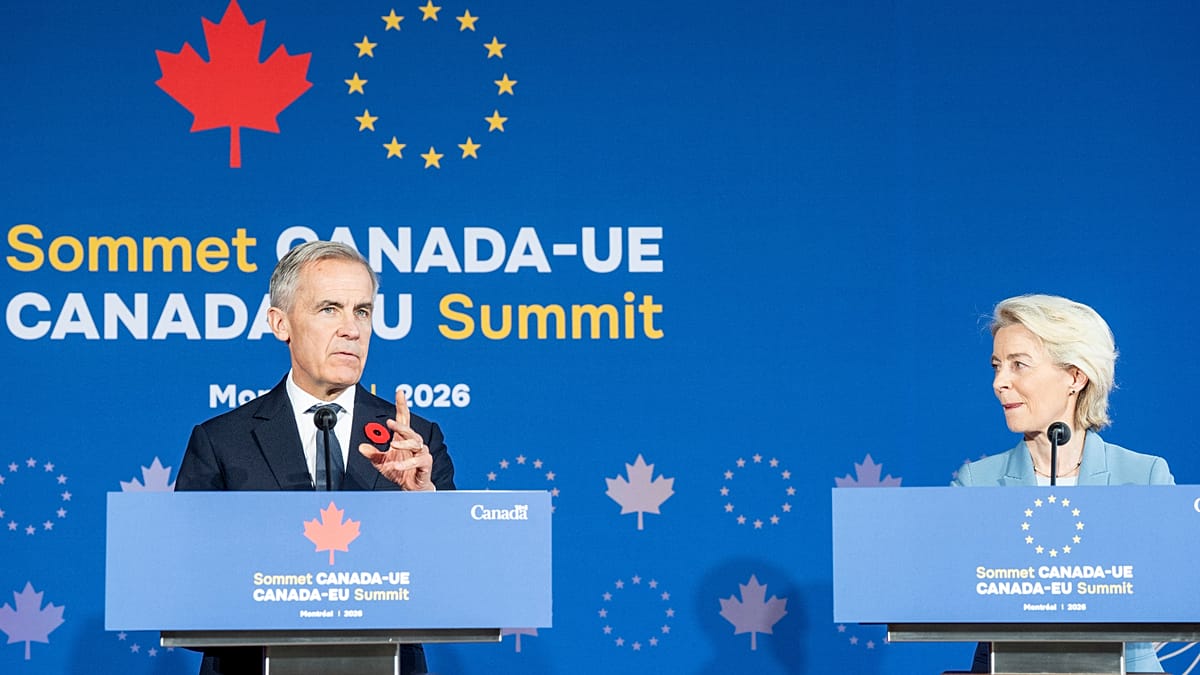
The EU-Canada energy alliance, highlighted at the Montreal summit in October 2026, is a significant development in transatlantic cooperation. However, the CBAM, which imposes a carbon cost on certain imports to protect European producers, could be a potential obstacle to this partnership. Canada, seeking to diversify its trade away from heavy dependence on the United States, is keen to access the EU market, but the CBAM may hinder this goal.
"Canada continues to seek a practical agreement with the EU to reduce CBAM's administrative burden for Canadian exporters, and the Prime Minister's Personal Representative to the European Union is fully engaged." - Internal Document, Canada's Trade and Foreign Affairs Ministries
The Canadian Perspective
Canada's reluctance to fully endorse the CBAM is rooted in its desire for an exemption, despite having its own carbon pricing policies and a close trade relationship with the EU under the Comprehensive Economic and Trade Agreement (CETA). The country wants its domestic carbon-pricing system to be recognized as comparable to the EU's, reducing the administrative and financial burden on Canadian businesses.
"Canada is facing an EU carbon tariff in the coming months that could affect $3 billion in Canadian exports. Instead of fixing the issue, the PM has spent months distracting Canadians with talk of the EU." - Stephanie Kusie, Canadian Conservatives' Shadow Minister for International Trade
The Impact on Canadian Exports
Between 2021 and 2024, Canadian exports of goods covered by the EU's carbon border mechanism averaged C$28 billion annually, representing 7.4% of Canada's exports to the bloc. The CBAM could pose challenges for Canadian exporters, particularly in industries like aluminium, steel, critical minerals, and hydrogen, due to carbon charges and complex administrative requirements.
Carbon Taxes: A Complex Issue
Carbon taxes have been a subject of debate, with some arguing that they are an effective tool to reduce emissions and promote green alternatives, while others believe they can harm industries and competitiveness. The implementation of carbon taxes in Canada has been a contentious issue, with varying opinions on their effectiveness and impact on the economy.
"Carbon taxes work and only the uneducated and willfully ignorant don’t see it. It’s complex, yes, but it works and doesn’t harm people the way many believe."
"Carbon taxes only work when there's a green alternative that is similarly comparable and the money is used for green investments not general budget."
Political and Economic Considerations
The political landscape surrounding carbon taxes is complex. The carbon tax was initially a Conservative policy in Canada, but it has become a divisive issue. The previous government's implementation of the tax was criticized for not being effective, and the current government's decision to cancel it has been met with mixed reactions.
"I'll remind any Canadians on this list that the carbon tax was the CONSERVATIVE'S policy to get a handle on climate change. And the way it was structured in Canada was that regular people got the carbon tax back. PP decided to wage war against the carbon tax. The carbon tax is gone and your gas isn't any cheaper. Plus you aren't getting a cheque from the government anymore."
"Unpopular opinion here but while it may have been good politics in Canada to cancel the 'carbon tax' (it wasn't a tax, it was a fee to pollute), it was very poor policy. A carbon fee / carbon tax is the most market-friendly way to price carbon, which will have be done whether we like it or not, and to make the economy more efficient."
Conclusion: A Balancing Act for Canada
Canada's position on the EU's CBAM is a delicate balancing act. While the country supports industrial carbon pricing, it seeks an exemption from the EU's tax, highlighting the complexities of international climate policy. The CBAM's potential impact on Canadian exports and the energy alliance with Europe adds another layer of consideration. As Canada navigates these challenges, the outcome will shape its relationship with the EU and its approach to climate action.

