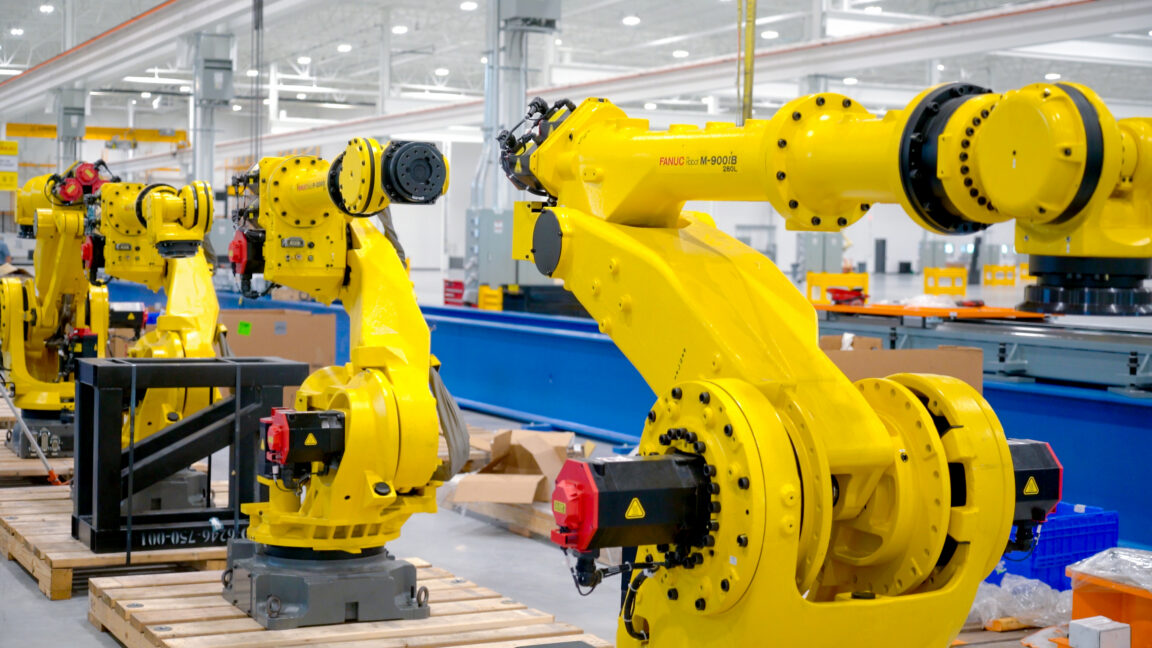
President Donald Trump issued a presidential proclamation declaring foreign-made factory robots and industrial machinery to be a national security threat. The directive orders new trade negotiations with foreign partners, opening the door to potential tariffs, quotas, and duties if agreements are not struck within 180 days. The decision subjects the heavy automation powering key American manufacturing lines to unprecedented government scrutiny.
Broad Mandate Hits Heavy Industry
The proclamation follows a Department of Commerce investigation led by Commerce Secretary Howard Lutnick. The inquiry concluded that reliance on foreign robotics threatens the long-term competitiveness of the United States and creates vulnerabilities within the domestic industrial base. Beyond economic dependencies, federal officials pointed to critical cybersecurity risks, warning that foreign machinery integrated into US supply chains could introduce backdoors into sensitive defense and infrastructure networks.
The scope of the policy touches the heart of American manufacturing. Industrial robotics form the backbone of production for defense hardware, weapon systems, and commercial transportation. Major corporations—including automakers General Motors, Ford, and Tesla, as well as aerospace giants Boeing and Lockheed Martin—depend heavily on specialized factory robots.
This broad focus marks a distinct pivot from earlier regulatory efforts. In July, the Federal Communications Commission targeted consumer and mobile robotics, placing bans on foreign-made robotic vacuums, four-legged robot dogs, and humanoid units while specifically carving out exceptions for fixed factory equipment. The new proclamation removes those exemptions, bringing heavy industrial arms and warehouse automation into the crosshairs.
The Domestic Supply Dilemma
At the core of the issue is a stark manufacturing reality acknowledged within the proclamation itself: the United States does not currently possess the domestic manufacturing capacity to supply its own demand for heavy industrial robotics.
American factories routinely turn to the global market’s leading robotics suppliers—FANUC, ABB, Yaskawa, and KUKA—headquartered in Japan, Switzerland, and Germany. No domestic manufacturer produces equivalent heavy-duty hardware at the scale required by modern assembly plants. Even technology giants with massive internal automation divisions, such as Amazon, rely on foreign-built robotic arms alongside their in-house developments.
With nearly 38,500 new industrial robot installations recorded in the United States over the past year, America stands as the world's second-largest robotics market. Imposing trade barriers or import fees on this hardware would directly increase capital costs for US companies attempting to modernize facilities.
"Major US automotive and aerospace companies often buy large robotic arms for factory floor work from the “big four” robotics makers—FANUC, ABB, Yaskawa, and KUKA—that are headquartered in Japan, Switzerland, and Germany. No US company currently offers comparable heavy-duty hardware for large industrial robotic arms, although the foreign robotics makers have been expanding their US engineering and assembly facilities."
Industrial Friction and Strategic Trade
The prospect of tariffs on critical equipment has raised immediate concerns across manufacturing and technology sectors. Critics argue that penalizing foreign machinery imports risks slowing down domestic productivity rather than accelerating local production.
"Any tariffs or other fees would, of course, be paid by the US companies importing such foreign-made robots. That would likely increase the cost of US manufacturing operations at a time when the United States has become the second largest market in using industrial robots"
Others point out the paradox of attempting to bootstrap high-tech domestic manufacturing while restricting access to the automated tools required to build those precise facilities.
"Robot guy here. The best way to manufacture robots is with a lot of robots.
I'll let you figure out how we get from A to B."
As the 180-day negotiation window opens, trade representatives face the delicate task of balancing national security mandates with the practical realities of industrial supply chains. Whether the administration resolves these concerns through trade concessions, domestic investment incentives, or sweeping import duties will determine how quickly American factories can adapt without stalling their ongoing automation efforts.

